The sport of Working Equitation evolved as a showcase of the skills in horsemanship needed on the cattle farms of Western Europe, particularly in the countries of Portugal, Spain, and the South of France. These European stockmen have a long history of training their horses in the Classical Equitation manner, from which many of the modern Equestrian sports were derived. Working Equitation has been a sport in Europe for the past 30 years, and in 2004, the Working Equitation communities of Portugal, Spain, France, and Italy came together to form the World Association for Working Equitation (WAWE), which soon attracted the other member countries of Germany, Belgium, England, Sweden, Switzerland, Austria, Australia, Holland, Czech Republic, San Marino, Brazil, Colombia, Slovenia, USA, and Mexico. These 19 Member Nations are soon to be joined by Canada, New Zealand, and South Africa.
As a rapidly-expanding international equestrian sport under WAWE, Working Equitation in each country has a common set of competition rules, which enables all member countries to participate equally at international competitions. These international competitions are an ethnographical and cultural showcase of both the different ways of riding used in practical working conditions in various countries, as well as showcasing each country’s traditional working clothing and working saddlery.
Working Equitation is not only a sport, but also an emerging training method for any “working” horse – that is, any horse that is ridden for any type of equestrian activity. The international slogan is “WORKING EQUITATION – the FUN way to train SERIOUSLY”. This Equestrian Discipline does concentrate on the ability of a horse and rider partnership to negotiate various types of obstacles encountered on farms or ranches, which are similar world-wide. So, even a rider who takes their horse for a hack may well encounter these obstacles, and would benefit to add this Discipline to their training programme.
ZAWE, the sole recognised Managing Body for Working Equitation in South Africa, believes that anyone who rides or wishes to ride a horse should be given the opportunity to participate in the sanctioned clinics and training events, with a view to choosing whether to compete or not. In this respect, ZAWE has coined an additional slogan, “WORKING EQUITATION – An Equestrian Sport for EVERYONE”. The ZAWE National Council and Executive Committee have built this facility into their Constitution, Policies, Rules, and Regulations, which comply with SAEF, SASCOC, Department of Sport and Recreation, and WAWE requirements.
1. Working Dressage:
Working Dressage is distinctly different from FEI or “Competition” Dressage, in that highly-expressive gaits are NOT the criteria. Rather, two important aspects revealing the welfare of the horse (primarily) are required. The first is the PARTNERSHIP between horse and rider, where an understanding between both scores higher marks. The second is the SHAPE of the horse, where a rounded top-line – giving the best weight-carrying posture for the horse, and where spinal processes are not compressed and pinching nerves – combined with a lateral flexibility in both directions is most desired. As the horse and rider partnership progress into the more advanced Working Equitation class levels, so the equitation principles of balance, collection, and impulsion are scored in conjunction with partnership and shape. Working Dressage promotes physical soundness and mental well-being through relaxation, lateral suppleness (bending), longitudinal suppleness (roundness), and progressive conditioning.
In Working Dressage, the 5 basic yields are taught earlier, and this leads to Working Dressage Tests seemingly more advanced than FEI Dressage at similarly-named levels. However, a correctly-prepared horse in terms of partnership and shape should have no difficulty in achieving the yields, in view of the fact that all 5 yields are needed to be able to properly execute fieldwork, as displayed in the Working Equitation arena in the Ease-of-Handling Phase (Phase 2).
2. Ease-of-Handling/ Maneability/Manageability (Obstacles):
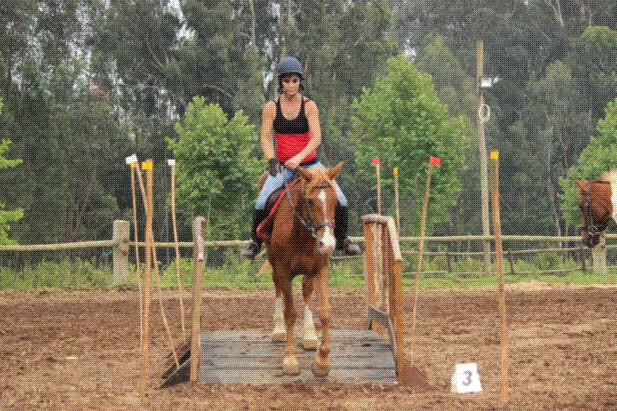
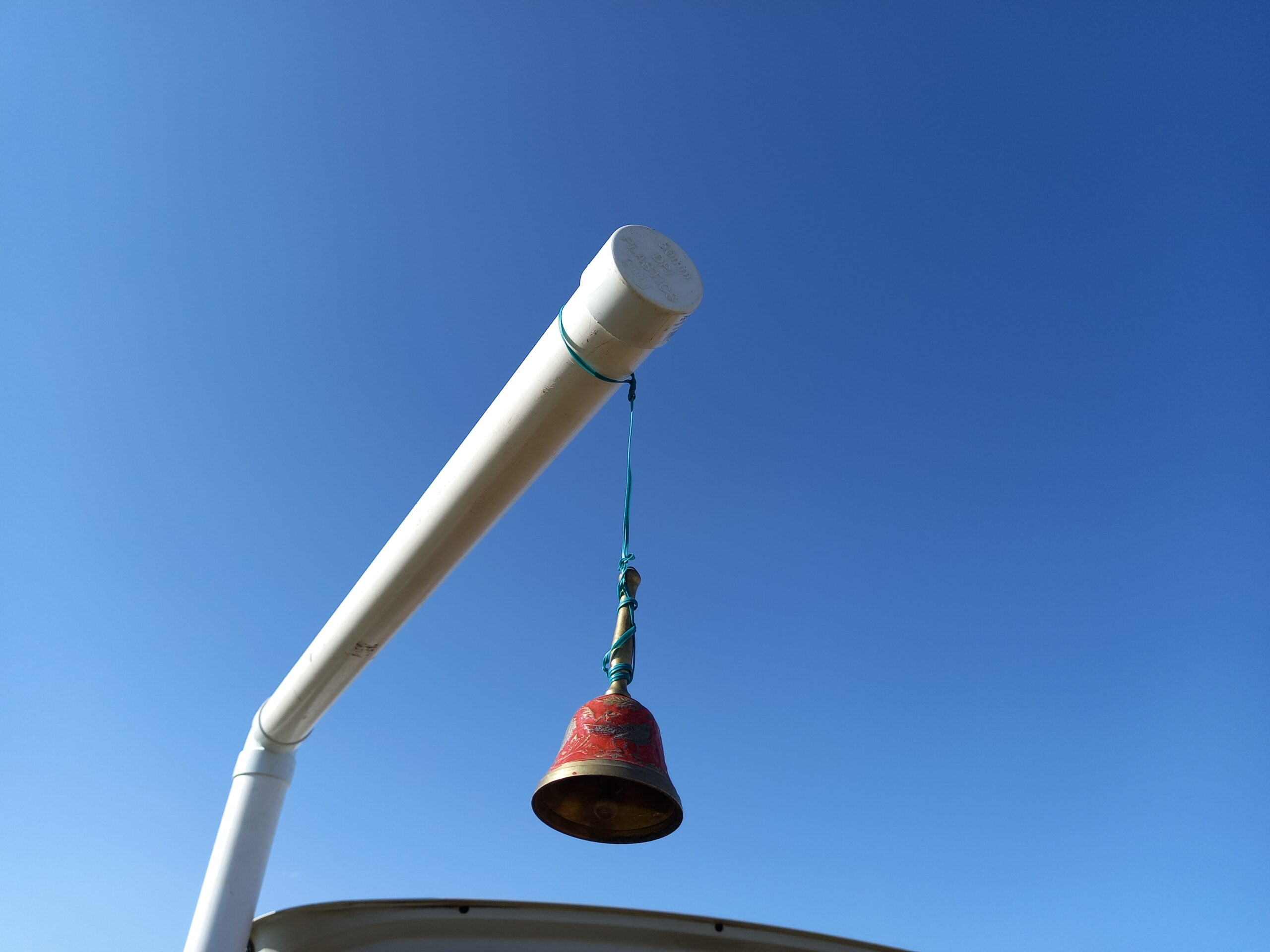
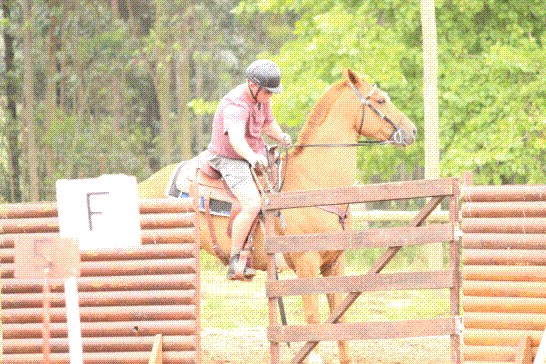
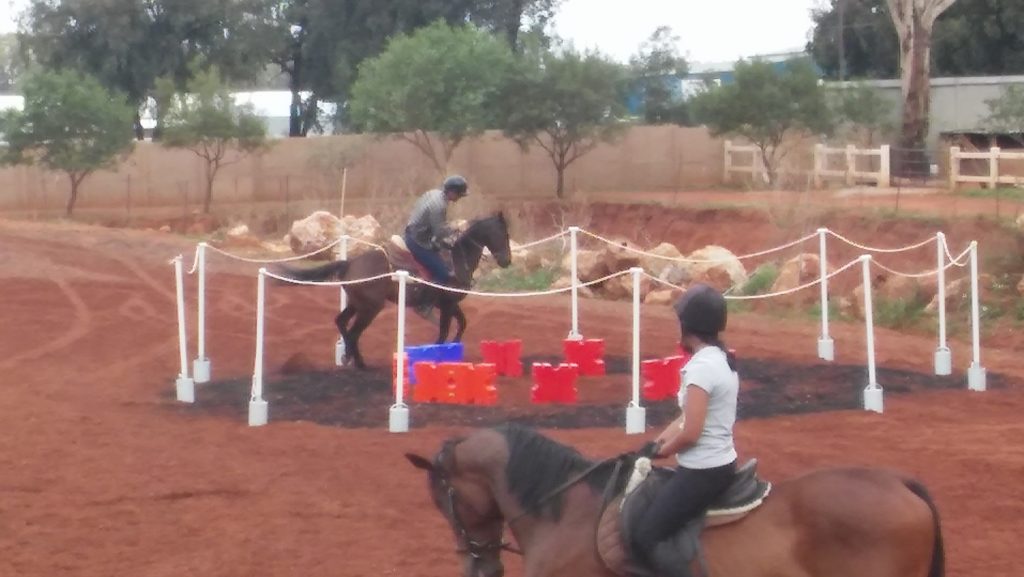
The Ease-of-Handling Phase involves a course of obstacles/challenges that are commonly encountered during a typical day in the life of a working horse/rider partnership. These include a variety of bridges, gates, ditches, banks, stock-pens, corridors, ringing bells, lifting objects (water jugs, sacks, or garments), side-passing, a small jump, slalom (real trees are substituted with poles or pot-plants), and picking up, using, and returning a pole (called a garroche in Europe) that – in the arena – is used to “spear” a ring off a stylised bull’s back.
Horse/rider partnerships at the lowest levels would walk through the obstacles, and walk/trot between obstacles. At the medium levels, cantering is introduced for a balanced horse with changes of lead progressing from the simple change through a trot, to simple change through a walk, to flying changes. Some obstacles are crossed only at a walk (the bridge is the one obstacle always executed at the walk for ALL levels, right up to the international Expert and Masters Levels).
The judging criteria in the Ease-of-Handling Phase are, firstly, PARTNERSHIP and understanding between horse and rider; secondly, calmness; thirdly, correct shape of the horse; and fourthly, PRECISION as opposed to speed. The highest marks are awarded to the horse/rider partnership that takes the precision factor to achieve round circles or half-circles, and transitions at precise points on the course, always keeping the horse in a good balance.
3. Speed (Obstacles):
The Speed Phase is the most spectacular phase of the Event. This Phase is scored purely on time. Beginner levels do not participate in this more technical Phase.
A properly-prepared horse, in partnership with an understanding rider, can most effectively complete this test with a high level of balance and collection.
The rider chooses the gait at which the horse is most comfortable, and a slower gait in the obstacles with a balanced and collected horse can sometimes be faster than an unbalanced horse attempting the obstacle at a faster gait.
The course for the Speed Phase is only a part of the Ease-of-Handling Course.
4. Cattle Handling:
Many working horses world-wide are used for stock work. This Phase is a test of how calmly and effectively the horse/rider partnership can separate one animal from a small herd of cattle kept in a holding area, and move it into a 3-sided pen some 50m away from the herd.
Cattle are numbered, and each participant draws a number before the Phase begins.
Normally, this Phase is a team event where 3 or 4 participants work together, however, the individual that draws the number is the only one who may approach the herd, and the team members can only help to guide the separated animal into the pen.
A time limit is given for each participant to complete the test.
Again, the beginner and medium levels do not participate in this Phase, which is reserved for the top Expert and Masters Levels.
So, with all of this background, who qualifies to participate in this exciting Equestrian Discipline so new to South Africa?
As previously mentioned, the South African Working Equitation Association (ZAWE) has the slogan “WORKING EQUITATION – An Equestrian Sport for EVERYONE”. Any person with a sound and fit horse or pony and that has neat and serviceable tack and clothing, which includes a hard-hat or a breed-specific form of headwear approved by the SAEF, may participate at any Working Equitation Event, including Clinics, Training Days, Mini-League Events, and Competitions. The only point to note here is that the tack and clothing should match the style of riding – eg. Western clothing with Western tack, English clothing with English tack. Club clothing is allowed at the lower levels of participation.
Some bits and bitless bridles are restricted, and so participants should find out what they are allowed to use before participating at any Working Equitation Event.
For Clinics, Training Days, and potentially Mini-Leagues, the only requirement is that a participant needs to belong to a ZAWE-registered Club that includes Working Equitation as a Discipline offered to its members. Many of the single-discipline Working Equitation Clubs offer free membership, as well as some multi-discipline Clubs.
However, once a rider chooses to participate competitively, then an “athlete” status is required, where Individual Membership of their Provincial Working Equitation Association as well as ZAWE and SAEF is needed. At this point in time, some of the Provincial Associations and ZAWE offer free Individual Membership, to keep the sport affordable and accessible to ANYONE who wishes to compete at Provincial and National Level.
Currently, 5 of the 9 Provinces in South Africa are Provincial Members of ZAWE, each having place for two representatives sitting on the National Council. These Provinces are Eastern Cape, Gauteng, KZN, North West, and Western Cape. Interest has been shown by individuals in the remaining 4 Provinces, however, support from the riding public interested in getting involved with Working Equitation is needed for them to be able to set up Provincial Associations that can join ZAWE as Provincial Association Members.
To keep returning to the theme of Working Equitation being a sport for Everyone, mention needs to be made that even officials who also wish to ride at ANY level of participation in the sport are being catered for, and a depth of “helpers” is being established at local level to allow this freedom of choice. An official, e.g. a Judge, will be given the chance to participate at his/her chosen level of participation in a class in which another judge will assume duties. Working Equitation in South Africa is therefore adding the dimension of “EQUALITY OF OPPORTUNITY” into our chosen sport, bringing as much fairness as possible into the equation.
ZAWE and the 5 Provincial Working Equitation Associations already established all have Facebook Pages that share information and videos on Working Equitation happenings in South Africa and world-wide, and you are encouraged to go to those Pages to see more.
ZAWE https://www.facebook.com/zaworkingequitation
Eastern Cape https://www.facebook.com/Eastern-Cape-Working-Equitation-120962988563500/
Gauteng https://www.facebook.com/wegauteng/
KwaZulu-Natal https://www.facebook.com/kznworkingequitation/
North West https://www.facebook.com/North-West-Working-Equitation-137344670338480/
Western Cape https://www.facebook.com/WCWEA/